Lighting the Path to Learning: Tespack’s Journey from Innovation to Impact
May 2025 |
In the heart of Uganda and Zambia, where rough dirt tracks often serve as the only roads and electricity remains a luxury for many, something remarkable is happening. In regions where only 36% of rural Ugandans and 14% of rural Zambians have access to electricity, the light of education is beginning to shine in the most unexpected places.
For children in these off-grid communities, the barriers are staggering. Classrooms without power, teachers without tools, and students without hope. In Uganda alone, more than 80% of ten-year-olds cannot read and understand an age-appropriate story. In Zambia, the learning divide between urban and rural schools remains deep and persistent. The COVID-19 pandemic only made things worse—one in three Ugandan students didn’t return to school when the lockdowns lifted.
But a spark of innovation from Finland set out to change that. Tespack began by designing smart solar backpacks for outdoor adventurers. But when Plan International approached them in 2019, a new idea was born—one that could change the trajectory of thousands of lives.
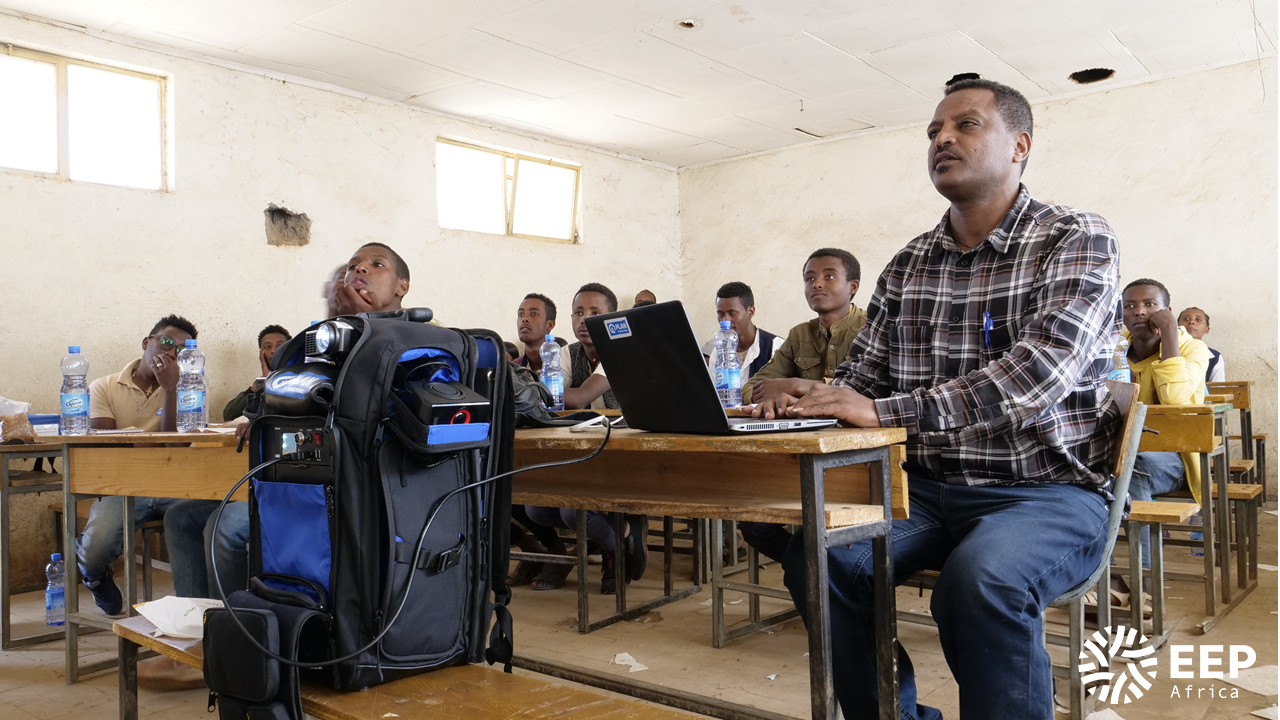
Together, they created the Smart Solar Media Backpack: a lightweight, mobile digital classroom-in-a-bag. Powered by the sun, equipped with a projector, speakers, and long-lasting batteries, the Backpack can transform any space—no matter how remote—into a vibrant, connected learning environment. Teachers could now project lessons, play educational videos, and connect to the internet, all without needing a grid.
But Tespack faced a hard truth—innovation alone wasn’t enough. Scaling a hardware-based solution is tough. Grants rarely fund hardware development. And the software needed better tools for managing energy use and tracking devices.
That’s where EEP Africa came in. With the support of an EEP Africa grant in 2020, Tespack launched a project to bring their vision to life. Over the next two years, they refined the Smart Solar Media System, tested it in the field, and laid the foundation for commercialisation.
Ten pilot units were distributed—eight in Uganda, two in Zambia—landing in the hands of NGOs, universities, and rural training centres. The feedback was invaluable. The system had to be even lighter, waterproof, and ready for transport on the back of a motorbike through muddy terrain. Tespack listened. They adapted. And they delivered.
In Uganda, you travel by motorbike. We had to make sure our system could keep up—with the rain, the roads, and the realities on the ground — Caritta Seppä, COO & Co-Founder, Tespack
EEP Africa’s funding helped Tespack not only improve its product but also its business model. They expanded their customer base, forged local partnerships, and started scaling beyond borders. Today, Tespack’s technology is in use across 15 countries, from Rwanda and Kenya to Laos and Timor-Leste. Over 150,000 people—students, teachers, farmers—have already benefited from access to digital education and training powered by the sun.
They’re working with global partners like UNICEF, UNDP, World Vision, and Save the Children, and even partnering with telecom companies to bring connectivity to the most underserved communities. Tespack is now fundraising to scale further, building towards a future where no child is left in the dark—where every classroom, no matter how remote, has the power to inspire.
EEP Africa allowed us to build and test our vision when no one else would fund hardware — Mario Aguilera, CEO & Founder, Tespack
Tespack’s journey is a testament to what’s possible when innovation meets opportunity. With the right support, even a backpack can become a beacon of hope. At EEP Africa, we believe in backing visionary entrepreneurs who tackle real challenges with bold ideas.
